
Crop rotation means moving each vegetable family to a different spot each year so pests and soil diseases lose their favorite host and your soil doesn’t get drained of the same nutrients over and over. You don’t need acres of land to do it. You need to know which family each vegetable belongs to, and a plan for where things go next season. Both are below.
Vegetable Plant Family Chart (Start Here)
Almost every rotation mistake starts with thinking about single vegetables instead of families. Peppers and tomatoes look nothing alike, but they share the same diseases. Move one and plant the other in its place, and you’ve rotated nothing.
Print this chart, screenshot it, tape it inside a shed door.
| Family | Vegetables in it | Feeder type | Good group to follow it with |
| Nightshades (Solanaceae) | Tomato, pepper, eggplant, potato, tomatillo | Heavy | Legumes |
| Brassicas (Brassicaceae) | Broccoli, cabbage, kale, cauliflower, Brussels sprouts, radish, turnip, collards, mustard greens, bok choy | Heavy | Roots and alliums |
| Legumes (Fabaceae) | Peas, green beans, dry beans, fava beans, peanuts | Light, and adds nitrogen | Brassicas or leafy greens |
| Cucurbits (Cucurbitaceae) | Cucumber, zucchini, summer and winter squash, pumpkin, melon, gourd | Heavy | Legumes |
| Alliums (Amaryllidaceae) | Onion, garlic, shallot, leek, chive | Medium | Legumes or cucurbits |
| Umbellifers (Apiaceae) | Carrot, parsnip, parsley, dill, fennel, celery | Light | Brassicas |
| Chenopods (Amaranthaceae) | Beet, Swiss chard, spinach | Medium | Legumes or alliums |
| Chicories and lettuce (Asteraceae) | Lettuce, endive, radicchio, artichoke, sunflower | Medium to heavy | Roots and alliums |
Bottom Line: Tomatoes and potatoes are cousins. Radishes belong with broccoli. Beets belong with spinach. Get those three right and most of the rest follows.
The 8 Vegetable Families You Need to Know
A quick tour, because the chart is easier to use once you know why each group behaves the way it does.
Nightshades
Tomatoes, peppers, eggplant, potatoes. This family causes the most trouble in home gardens, mostly because it’s the family people grow every single year in the same sunny bed. They’re heavy feeders and they carry a long list of soil diseases. If you only rotate one group, rotate this one.
Never follow potatoes with tomatoes, or the other way around. They pass late blight and a few other problems back and forth.
Brassicas
Broccoli, cabbage, kale, cauliflower, Brussels sprouts, collards, mustard, bok choy. Radish and turnip belong here too, which catches a lot of people out. They look like root crops, so they get filed with carrots and beets. They aren’t.
Brassicas want nitrogen-rich soil, which is why they follow legumes so well. They also share pest problems, especially cabbage moths, so growing them together makes netting far easier.
Legumes
Peas, beans, fava beans. These are your soil builders. Bacteria on their roots pull nitrogen out of the air and store it in nodules, and some of that stays behind for the next crop.
When your peas or beans finish, cut them off at ground level instead of pulling them. Leave the roots in the soil.
Cucurbits
Cucumbers, zucchini, squash, pumpkins, melons. Big plants, big appetites, and they sprawl over more ground than you planned for. One zucchini plant feeds most families, which is a lesson people usually learn the hard way in year one.
Because they’re heavy feeders, follow them with legumes if you can.
Alliums
Onions, garlic, shallots, leeks, chives. Moderate feeders with shallow roots, and they take up very little horizontal space. That makes them useful for filling gaps. They pair naturally with peas and beans, which want similar soil.
Umbellifers
Carrots, parsnips, parsley, dill, fennel, celery. Light feeders with deep roots. Those roots do real work down there, breaking up compacted layers and pulling minerals up from the subsoil where shallower crops can’t reach.
Chenopods: Beets, Chard, and Spinach
Most rotation charts skip this family entirely, which is strange, because beets and chard are in nearly every home garden. Beets, Swiss chard, and spinach are all related. They’re close enough that a leaf miner problem in your chard will happily move over to your beets.
If you’ve been putting beets in the root crop bed with carrots, that’s a reasonable simplification. Just know they aren’t actually related.
Chicories and Lettuce
Lettuce, endive, radicchio, and, oddly enough, sunflowers and artichokes. Lettuce is a surprisingly hungry crop for something so small and quick. It’s also fast, which makes it a good filler between longer-season crops.
The Odd Ones Out
Corn, okra, and sweet potato are each the only member of their family most of us grow. You can’t rotate them against a sibling because they don’t have one in your garden. Move them around anyway. Corn in particular benefits, since corn rootworm builds up when it stays put.
The 4-Bed Rotation Plan
Four beds is the sweet spot. It gives you enough separation to matter, and it’s simple enough to remember.
Group your crops into four blocks:
- Legumes and greens: peas, beans, lettuce, spinach, chard
- Brassicas: broccoli, cabbage, kale, radish, turnip
- Fruiting crops and potatoes: tomatoes, peppers, eggplant, potatoes, squash, cucumbers, melons
- Roots and alliums: carrots, beets, parsnips, onions, garlic
Notice where the potatoes went. Plenty of rotation charts file potatoes with carrots and beets because they all grow underground, and that quietly ruins the whole plan. Potatoes are nightshades. They belong with the tomatoes, no matter what part of the plant you eat.
Year-by-Year Rotation Table
Each group moves one bed forward every year. After four years, everything is back where it started.
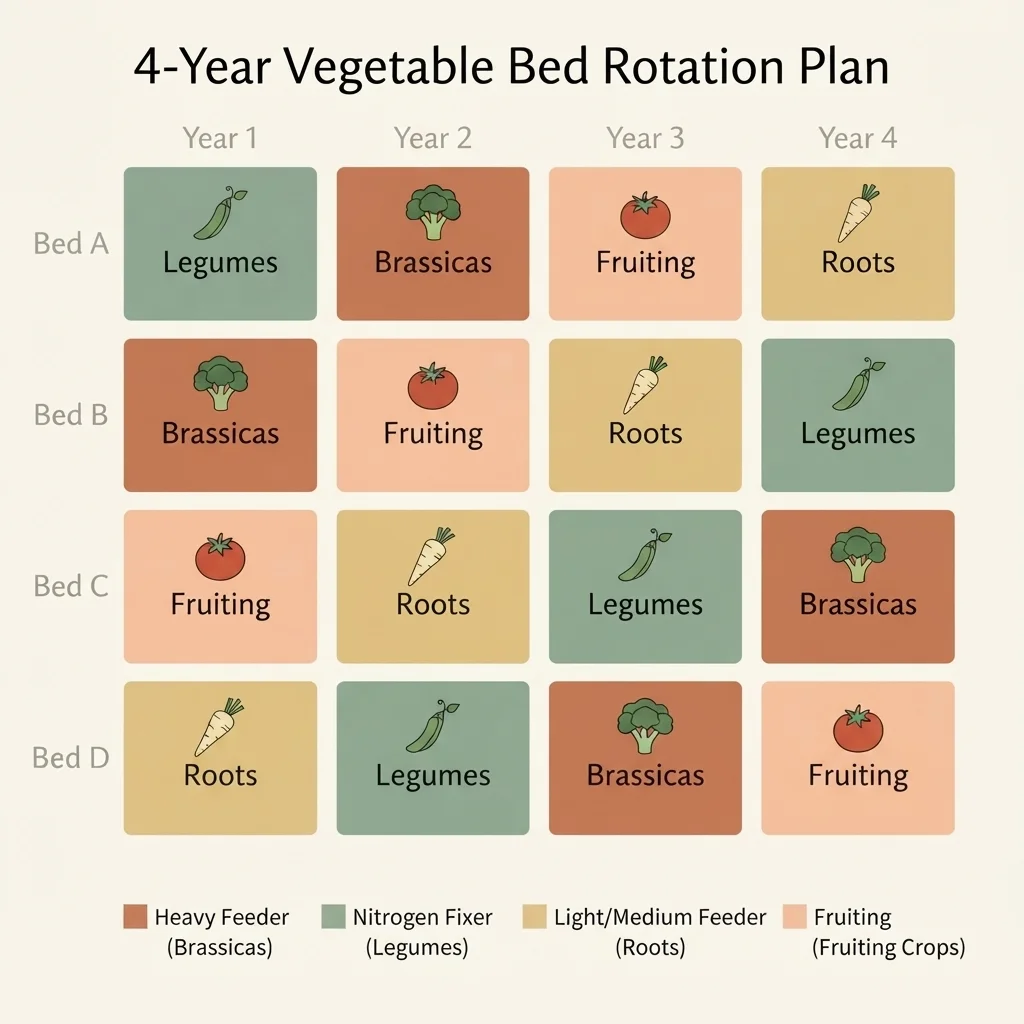
| Year 1 | Year 2 | Year 3 | Year 4 | |
| Bed A | Legumes and greens | Brassicas | Fruiting crops and potatoes | Roots and alliums |
| Bed B | Brassicas | Fruiting crops and potatoes | Roots and alliums | Legumes and greens |
| Bed C | Fruiting crops and potatoes | Roots and alliums | Legumes and greens | Brassicas |
| Bed D | Roots and alliums | Legumes and greens | Brassicas | Fruiting crops and potatoes |
Pick any starting year you like. The order matters, not the starting point.
Why This Order Works
It isn’t random. Legumes leave nitrogen behind, so brassicas follow them and use it. Brassicas come out early enough in most regions to leave the bed in decent shape for hungry fruiting crops. Those fruiting crops drain the bed, so light-feeding roots and alliums come next and give the soil a breather. Then legumes come back around and start rebuilding.
Read down any column and you’re looking at one season. Read across any row and you’re looking at four years in one bed.
How to Adapt the Plan to What You Actually Grow
Nobody grows in even quarters. Most gardeners I know grow half a bed of tomatoes and about six radishes.
Adjust like this. If a group barely exists in your garden, fold it into a neighboring group rather than giving it a whole bed. Light legume growers can put peas and beans along one edge of the greens bed. If you grow a lot of one family, give it a bed and a half and shift the whole cycle around it.
The plan is a track, not a cage. As long as each family lands somewhere new each year and works its way back around slowly, you’re rotating. If you’re still mapping out where beds will go, our guide to planning a garden layout covers spacing and sun before you commit to a shape.
How to Rotate When You Only Have 1, 2, or 3 Beds
Most rotation advice quietly assumes four equal beds and then wishes you luck. This section is for everyone else.
Rotating Within a Single Bed
One bed still counts. Divide it into three or four sections and move each group along one section per year, the same way the four-bed plan works.
You won’t get the pest separation that real distance gives you. You will get the nutrient balance and some disease benefit, because many soil pathogens need the host plant present to keep multiplying. Take the win that’s available.
One thing worth knowing about a single bed: crop it hard and it will need more compost than a rotated system, not less. In a small space you lean harder on feeding.
The 2-Bed Split Rotation
With two beds, split each one down the middle. That gives you four planting zones, and the four-group plan works with a small change. Your groups move around the loop A-left, A-right, B-left, B-right, then back to the start.
Keep the nightshades and the brassicas on opposite beds every year. Those two groups cause the most trouble and gain the most from separation.
The 3-Bed Rotation
Three beds is easy. Drop to three groups instead of four:
- Legumes and greens
- Brassicas, roots, and alliums
- Fruiting crops and potatoes
Rotate one bed forward each year. Three years between nightshade plantings in the same soil is the standard minimum most extension services recommend, so a three-bed cycle hits the target without any extra thought.
Working Around Permanent Trellises and Cages
This is the practical wall people hit. You build a nice trellis on the north end of Bed B, and now your cucumbers live in Bed B forever.
Three ways around it:
- Swap climbers within the trellis spot. Cucumbers one year, pole beans the next, then peas. Different families, same structure. This alone solves most of the problem.
- Build trellises you can move. Cattle panel arches and A-frames lift out in a few minutes. Posts sunk in concrete do not.
- Put the trellis on the rotation. If two beds both have a north-end support, alternate which one gets the heavy climber.
I got this wrong the first time and set a trellis into a bed I later wanted for tomatoes. Now anything I build for a garden bed comes apart with a drill.
Does Crop Rotation Actually Work in a Small Garden?
Plenty of experienced gardeners online will tell you rotation is farm advice that got copied into garden books and doesn’t do much in a backyard. It’s a fair question and it deserves a straight answer.
Short version: rotation helps less than the textbooks suggest for nutrients, and more than the skeptics suggest for disease.
What Compost Fixes, and What It Doesn’t
The argument against rotating in small gardens goes like this. If you’re adding compost every year, you’re replacing the nutrients your crops removed, so why bother moving things?
That argument is half right. Compost really does handle the nutrient side. A well-fed bed doesn’t need rotation to stay fertile.
But compost does nothing about the fungal spores sitting in that soil from last year’s wilted tomato. It doesn’t clear out root-knot nematodes or remove clubroot spores from a brassica bed. Those are living organisms waiting for the right host to show up again, and the only thing that starves them is not giving them that host.
So the honest framing is this. Rotate for disease and pests. Feed for fertility. They’re two separate jobs, and one won’t cover for the other. Our guide to preparing garden soil handles the feeding half.
Why Distance Matters Less Than Time
People assume rotation works by moving plants far enough away that pests can’t find them. In a 20-foot garden, that clearly fails. A cutworm can cross your whole plot.
Time is doing most of the work, not distance. When a soil pathogen goes a season or three without its host plant, its population drops. Some die off, some go dormant, some get outcompeted by other soil life. Moving your tomatoes eight feet doesn’t fool anything. Leaving that soil tomato-free for three years genuinely reduces what’s living in it.
The years matter more than the feet. That’s why rotation in a small garden is still worth doing.
The Raised Bed Problem Nobody Warns You About
Now for the one that catches people by surprise. Raised beds filled with bagged potting mix, with no rotation, tend to lose steam by the second or third season.
University of Arizona Cooperative Extension has written about exactly this pattern, noting that the calls they get about declining raised beds almost always trace back to two things: soilless bagged media, and the same crops planted in the same box year after year.
Bagged mix is mostly peat, bark, and perlite. It drains beautifully and works poorly as a long-term soil, because it has almost no mineral content and a thinner biological community than real garden soil. Thin biology means fewer organisms competing with pathogens.
If your beds are two or three years old and things are slowly getting worse, look at those two things before you blame your watering. Mixing real topsoil and compost into the bed helps, and so does the rotation plan above. There’s more on building beds that hold up in our guide to raised bed gardening.
Why Crop Rotation Works
Now that you have the plan, a look at what’s actually happening in the soil.
It Breaks Soil-Borne Disease Cycles
Most of the diseases that ruin a vegetable crop live in the soil between seasons. Fungal spores, bacteria, and nematodes hang on in old root fragments and plant debris, waiting.
They’re picky eaters. A disease that attacks tomatoes usually can’t do much with carrots. Plant carrots there instead, and that pathogen spends a whole season with nothing to feed on. Do that for two or three years and its numbers fall enough to matter.
Clemson’s Home and Garden Information Center puts it plainly: rotating crops interrupts the life cycle of pathogens, insects, and nematodes by taking away the host they need.
Rotation isn’t a cure. It’s population control.
It Disrupts Overwintering Pests
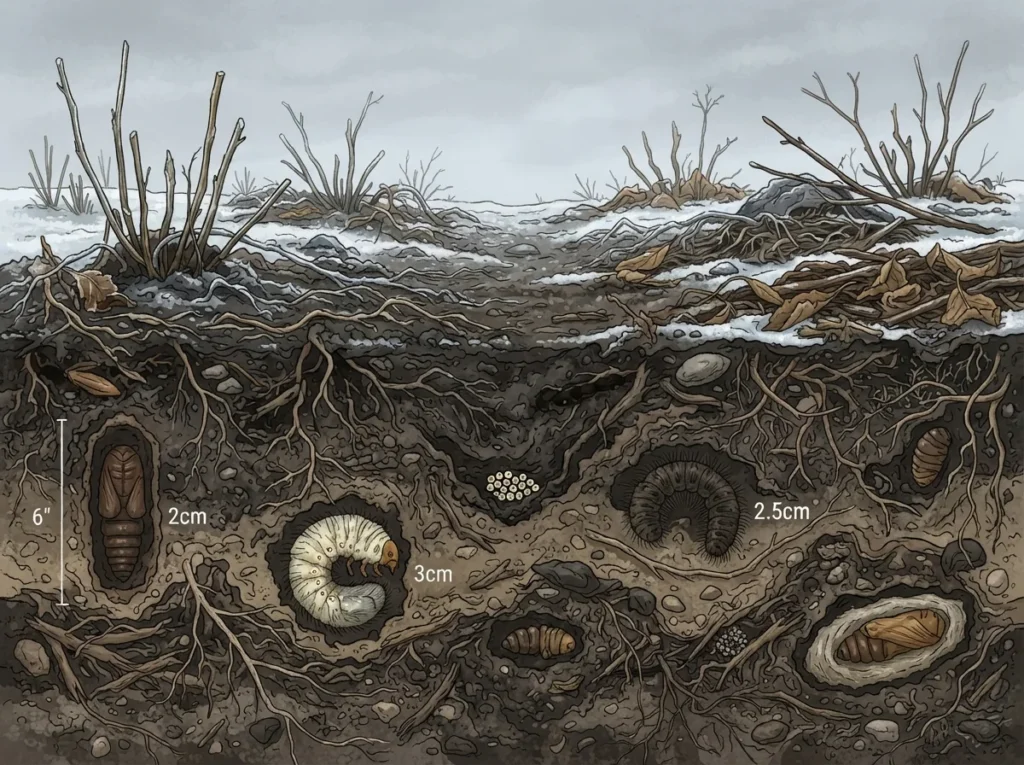
Plenty of garden pests spend the winter in the soil as eggs, larvae, or pupae, right under the plant they fed on. They emerge in spring expecting the same meal in the same spot.
Squash vine borers, Colorado potato beetles, and corn rootworm all work this way. Move the host and the timing falls apart for them. They still find your garden eventually, since most of them fly, but they arrive later and in smaller numbers. Later is often enough. Squash that reaches mid-July before the borers show up is a much bigger plant than squash that gets hit in June.
It Balances Nutrient Demand
Different families pull different things out of the soil. Tomatoes and corn are hard on nitrogen. Root crops draw more heavily on potassium. Alternate them and no single nutrient gets hammered season after season.
Legumes flip the equation entirely. The Rodale Institute’s overview of crop rotations uses the classic example of following corn with beans, since corn is a heavy nitrogen user and beans put nitrogen back.
It Improves Soil Structure
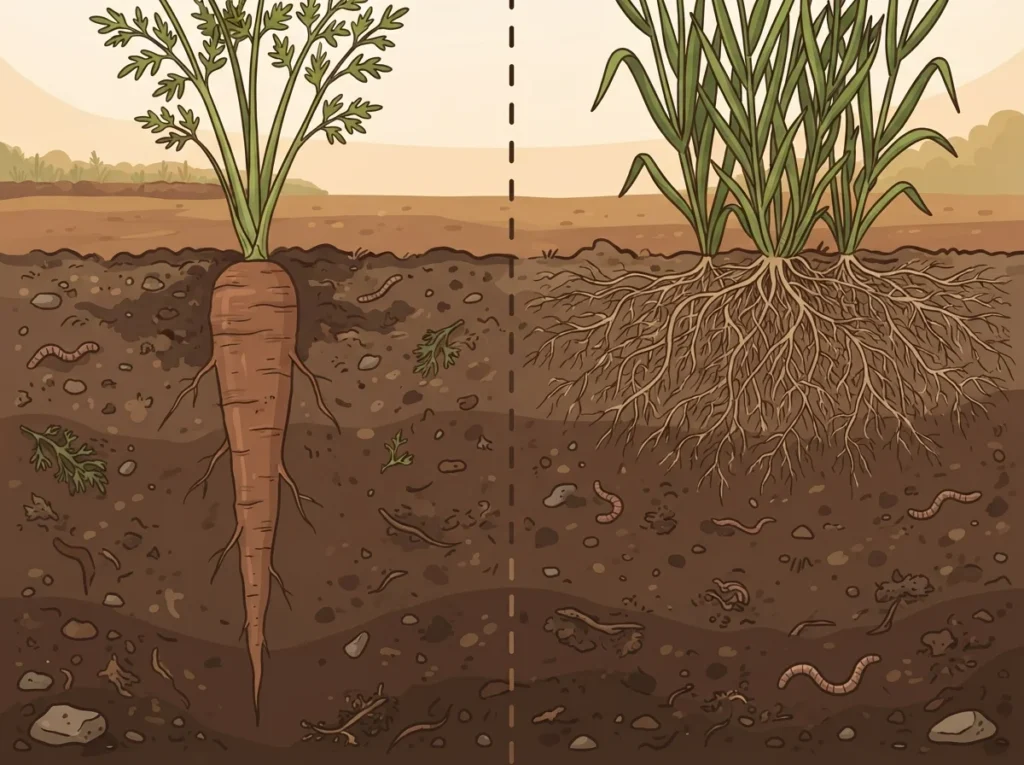
This benefit gets overlooked. Root systems are not interchangeable.
Carrots, parsnips, and tomatoes send roots deep and open up channels that air and water follow long after the plant is gone. Lettuce and onions stay shallow. Alternating deep and shallow rooters works the whole soil profile instead of the top six inches.
You can feel the difference with a spade. A bed that grew parsnips is noticeably easier to dig the following spring.
How Many Years Before You Repeat a Crop?
Everybody asks this, and the answer you get depends on who you ask. Three years. Four years. Some organic farms run seven to ten.
Nobody agrees because they’re answering different questions. The right gap depends on which problem you’re trying to avoid.
Rotation Length by Disease
| Problem | Family it hits | How long it can persist in soil | Practical gap |
| Early blight | Nightshades | About a year on crop debris | 2 to 3 years |
| Septoria leaf spot | Nightshades | Overwinters on debris | 2 years plus cleanup |
| Late blight | Nightshades | Rarely survives cold winters in soil, but lives in leftover potato tubers | Rotation helps little; pull volunteer potatoes |
| Fusarium wilt | Nightshades, cucurbits | Many years | 4 years plus resistant varieties |
| Verticillium wilt | Nightshades and others | Several years | 4 years plus resistant varieties |
| Clubroot | Brassicas | Resting spores last many years | Longest gap you can manage; raise soil pH |
| White rot | Alliums | Extremely long-lived | Rotation alone won’t clear it; avoid bringing it in |
| Root-knot nematode | Many families | Persists in soil | Rotate to non-host crops |
Persistence varies with climate, soil type, and how thoroughly you clean up at the end of the season. Check with your local extension office for regional specifics.
Two things jump out of that table.
First, a three-year rotation genuinely solves the common leaf diseases, and those are the problems most home gardeners actually have.
Second, rotation alone does not solve the long-lived ones. If clubroot or white rot gets into your garden, no realistic home rotation will clear it. Those become resistant-variety and soil-management problems instead.
The Realistic Minimum for Home Gardens
Three years. Most extension services land on that number, and a three or four bed rotation delivers it automatically.
Four is better if you have the beds for it. Anything longer than four is farm territory and isn’t worth chasing in a backyard.
If you can only manage two, do two. Two years beats zero by a wide margin, and it’s a lot better than the year-after-year tomato bed most gardens start with.
Crops That Need the Longest Break
Not everything is equally urgent. If you have to prioritize, these are the crops where the gap matters most:
- Potatoes and tomatoes. Longest list of soil problems, and they share most of them.
- Brassicas, if clubroot exists in your area.
- Onions and garlic, because allium soil diseases are stubborn.
- Peppers and eggplant, since they inherit the tomato family’s troubles.
Lettuce, carrots, radishes, and beans are far more forgiving. Nobody’s garden failed because the lettuce came back to the same corner two years running.
Heavy Feeders vs. Light Feeders
Family grouping tells you what to keep apart. Feeding level tells you what order to put them in.
Feeder Chart
| Feeding level | Crops | What they need |
| Heavy | Tomatoes, peppers, eggplant, corn, squash, cucumbers, broccoli, cabbage, cauliflower, lettuce | Rich soil, generous compost, often extra nitrogen mid-season |
| Medium | Potatoes, beets, chard, spinach, onions, garlic, leeks | Moderate compost, occasional feeding |
| Light | Carrots, parsnips, radishes, turnips, most herbs | Do fine in a bed that just grew a heavy feeder; heavy nitrogen gives you leafy tops and hairy roots |
| Builders | Peas, beans, favas | Add nitrogen instead of taking it |
That last row is the useful one. Legumes are the only group that leaves the bed richer than they found it.
How Legumes Put Nitrogen Back
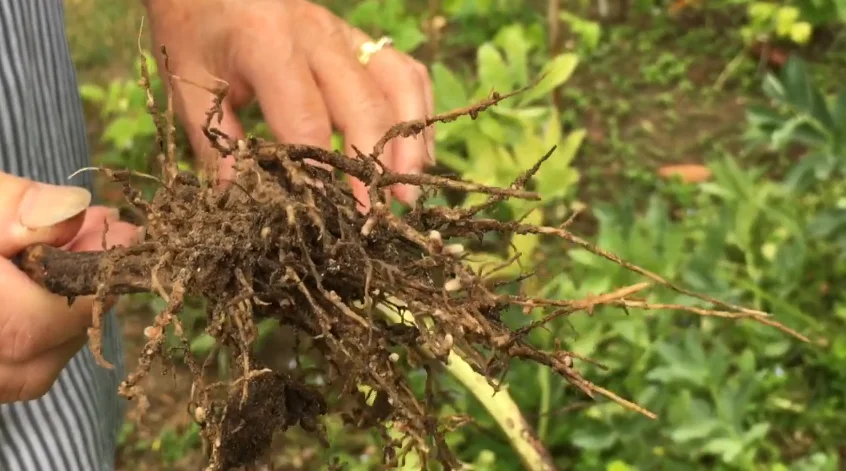
Pull up a healthy pea plant and look at the roots. Those little pink or white bumps are nodules, and inside them, Rhizobium bacteria convert nitrogen from the air into a form plants can use. It’s a trade. The plant feeds the bacteria sugar, the bacteria feed the plant nitrogen.
Be realistic about the size of the gift, though. Most of that nitrogen ends up in the pods and the top growth, so if you harvest the peas and pull the whole plant, you carry most of it off to the kitchen. What stays behind is what’s in the roots and nodules, which is exactly why leaving them in the ground is worth the ten seconds it takes.
The Simple Feeding Sequence to Follow
Strip away everything else and rotation order comes down to one line:
Legumes, then brassicas, then fruiting crops, then roots, then back to legumes.
Builders feed the hungry leaf crops. Hungry leaf crops make way for hungry fruit crops. Light-feeding roots clean up. Builders start over.
Run that sequence in four beds, three beds, or four sections of one bed. The logic doesn’t change with the size of the garden.
Crop Rotation vs. Succession Planting vs. Companion Planting
These three get mixed up constantly, partly because they overlap.
| What it is | Timescale | Main goal | |
| Crop rotation | Moving plant families to different ground each year | Years | Break pest and disease cycles, balance nutrients |
| Succession planting | Replanting a space as soon as one crop finishes | Weeks to months, within one season | Get more harvests from the same space |
| Companion planting | Growing certain plants next to each other on purpose | Same time, side by side | Deter pests, use space well, support pollinators |
Rotation is about where. Succession is about when. Companion planting is about next to what.
When Succession Planting Is Also Rotation
The overlap between the first two is genuinely useful once you see it.
If your spring lettuce comes out in June and you put bush beans in that spot, you just did both at once. You got a second harvest from that space, and you followed one family with a different one.
String a season together that way and a single bed might grow spinach, then beans, then fall kale. Three families, one year, one spot, and real rotation work happening between them.
I stopped treating these as separate practices a few seasons ago. Now when a crop comes out, my first question is which family was just there, and the answer usually picks the next crop for me. Our guide to when to plant vegetables covers the timing side.
Exceptions: Crops You Shouldn’t Rotate
Not everything moves.
Perennial Vegetables and Herbs
Asparagus, rhubarb, horseradish, and most woody herbs stay put. Asparagus takes two or three years before it produces properly, and moving it resets the clock. Rhubarb behaves the same way.
Give perennials their own permanent corner outside the rotation beds entirely. Mint especially, because mint will take over a rotation bed and never leave.
Containers and Grow Bags
Containers work differently. You aren’t rotating the plant, you’re replacing the soil.
For pots that grew a healthy crop, top off with fresh compost and reuse the mix for a different family next year. For any pot that held a diseased plant, dump the mix and start fresh. It costs a few dollars and saves a season.
Grow bags make this easy, which is one reason they’re a good escape hatch when your beds are locked up. Our container gardening guide covers soil mixes in more depth.
Interplanted or Scattered Gardens
Some gardeners skip blocks entirely and tuck a tomato here, a pepper there, lettuce in the gaps. It’s an attractive way to garden and it does spread pest pressure out.
Tracking gets harder, though. If you garden this way, keep a rough map anyway, and at minimum avoid putting nightshades back in the exact same holes. You lose some precision and gain some diversity, which is a fair trade if you’re honest about it.
What to Do When You Can’t Rotate
Sometimes there’s no way to move a crop. One bed, one sunny spot, one thing you want to grow. Use this as the backup plan.
Choose Disease-Resistant Varieties
This is the single most effective substitute. Tomato varieties carrying V, F, and N in their name resist verticillium wilt, fusarium wilt, and nematodes. Breeders release new resistant varieties every year.
Heirlooms are the tradeoff. They taste wonderful and most of them carry almost no disease resistance. If you’re growing in unrotated soil, lean on resistant hybrids for your main crop and grow one heirloom for the pleasure of it.
Move the Crop to Containers for a Season
Give the bed a year off from that family by growing it in pots or bags instead. Same crop, entirely fresh soil, no rotation needed. Five-gallon buckets and 15-gallon fabric bags both work fine for a tomato.
Replace or Refresh the Bed Soil
If a bed has a real disease problem and you can’t rotate out of it, replacing the top eight to twelve inches is a blunt but effective fix. Not fun, not cheap, but it works.
A gentler version: dig in several inches of finished compost and let the bed sit through winter under mulch. More biology means more competition for pathogens. It won’t clear clubroot, but it helps with the common problems.
Use a Cover Crop as a Rest Year
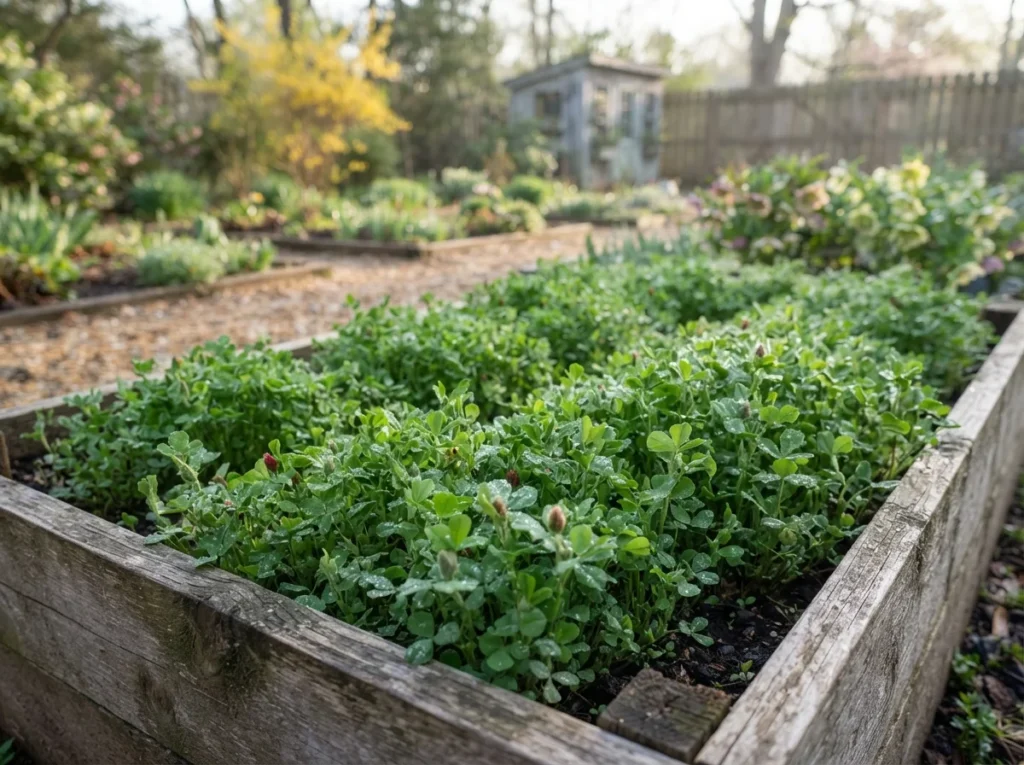
Instead of leaving a problem bed empty, plant it to a cover crop for a season. Crimson clover, field peas, or oats will hold the soil, feed the biology, and add organic matter, all while giving your vegetable pathogens a year with nothing to eat.
Sowing in early fall and cutting it down in spring fits most home gardens without giving up a summer.
How to Keep Track of What You Planted Where
Rotation only works if you can remember last year. By March, you won’t. I’ve been certain I knew where the tomatoes went and been wrong two years running.
The Simple Sketch Method
Draw your beds on a page. Write in each crop and, next to it, the family. That second part is what makes the note useful three years later, when “Cherokee Purple” means nothing but “nightshade” means everything.
One page per year, all pages in one notebook. That’s the entire system.
Photo Method
The fastest system of all: photograph each bed two or three times a season with your phone. The photos are automatically dated and located, and they capture things a sketch misses, like which end of the bed got shaded out by August.
Quick Tip: Take one photo of each bed on the same weekend every year. Same angle, same time of year. After three seasons you’ll have a record that shows not just what you planted, but how the soil and the plants are trending.
Common Mistakes to Avoid
These are the ones I see most, and most of them I’ve made.
Rotating Vegetables Instead of Families
Moving tomatoes out and planting peppers in their place feels like rotation. It isn’t. Same family, same diseases, same result.
Common Mistake: Following tomatoes with peppers or eggplant. If you’ve been doing this and wondering why rotation isn’t helping, this is almost certainly why.
Assuming Compost Replaces Rotation
Compost handles fertility. It doesn’t remove pathogens. A well-composted bed with four years of tomatoes behind it can still be full of wilt.
Misfiling Radish, Corn, Beets, and Potatoes
Radishes are brassicas, not roots. Corn is a grass with no family partner in most gardens. Beets are related to chard and spinach, not carrots. And potatoes are nightshades even though they grow underground. These four trip people up more than anything else on the chart.
Planting Tomatoes After Potatoes
The classic error. Both are nightshades and both carry late blight, which means a rough potato year can set up a rough tomato year in the same soil. Keep two or three years between them.
Not Writing It Down
Every rotation plan that fails, fails here. It isn’t a knowledge problem, it’s a memory problem. Sixty seconds with a pen in October saves the whole system.
Crop Rotation FAQs
What can I plant after tomatoes?
Plant legumes, brassicas, roots, or alliums after tomatoes. Peas and beans are the best choice because they add nitrogen back to soil the tomatoes drained. Avoid peppers, eggplant, and potatoes, since they’re in the same family and share the same diseases.
What family are beets in?
Beets belong with Swiss chard and spinach. They aren’t related to carrots, even though both are grown as root crops. Rotate beets away from chard and spinach, not away from carrots.
Does rotation matter in a brand-new garden’s first year?
Not really. In year one there’s no pest or disease buildup to break yet. What matters that first season is writing down what you planted where, because that record is the only thing that makes year two’s rotation possible. Build the habit before you need it.
How do I rotate when my beds get different amounts of sun?
Sunlight wins. Move crops between beds that share similar light rather than pushing a sun-loving group into shade where it won’t produce anyway. If only one bed gets full sun, keep the tomatoes and peppers there and rotate them between sections of that bed instead of across the garden.
What if I don’t know what was planted here before I moved in?
Start your own record this season and treat the history as unknown. Volunteer plants are your best clue. Potato sprouts or tomato seedlings coming up on their own tell you a nightshade grew in that spot recently, so give that area something from a different family this year.
Do herbs and flowers count in a rotation?
Annual herbs and flowers belong to plant families too, so they can fill a rotation slot. Dill and cilantro sit in the carrot family. Marigolds and sunflowers sit in the lettuce family. Perennial herbs like rosemary, sage, and thyme stay put and sit outside the rotation entirely.
Is rotating the same as leaving a bed fallow?
No. Fallow means growing nothing there for a season. Rotation means growing something different. Bare fallow ground tends to lose structure and grow weeds, so if you want to rest a bed, a cover crop rests it better than leaving it empty.
What happens if I skip a year?
Usually nothing dramatic. One repeat season rarely causes visible damage, but it does let soilborne pests and diseases hold their numbers instead of declining. Treat it as restarting the clock for that family, and plan a longer gap the next time around.
Does rotation work in a greenhouse or hoop house?
It matters more under cover, not less. Protected soil stays warm and dry, which suits many soilborne pathogens, and growers tend to plant the same few crops in there year after year. Rotate between beds inside the structure, or replace the soil in problem sections.
Does rotation still apply in a no-dig garden?
Yes. No-dig builds soil life that suppresses some problems, but it doesn’t remove host-specific diseases already sitting in the bed. The two practices work together, since rotation moves the plants rather than the soil.
Does crop rotation help with weeds?
Somewhat. Crops that get planted, spaced, and harvested on different schedules disrupt weeds that have adapted to one pattern. The effect is real but small at garden scale. Mulch and regular hoeing do far more.
Key Takeaway
Key Takeaway: Rotation comes down to two things. Know which family each vegetable belongs to, and give each family at least three years before it returns to the same soil. In a four-bed garden that’s a simple loop: legumes, brassicas, fruiting crops, roots, repeat. In one bed, it’s the same loop across four sections.
You don’t need a perfect system. You need a written record and a rough plan you actually follow. Rotation won’t prevent every problem, and it won’t fix soil that’s already been depleted for years. What it will do is stop your garden from getting quietly worse, season after season, in a way that’s hard to notice until the harvest tells you.
Start this fall. Sketch your beds, write down the families, and next spring you’ll already be ahead.
