How Often to Water Your Vegetables Garden the Right Way
I used to water my garden every single evening without thinking about it, just because it felt productive.
Turns out I was doing my tomatoes more harm than good, shallow daily watering trains roots to stay near the surface instead of digging deep for moisture on their own.
Key Takeaway: Once I switched to watering less often but more thoroughly, my plants actually handled dry spells better.
This guide covers exactly how often to water your vegetable garden and how to actually tell when it needs it, rather than just guessing on a schedule.
It focuses specifically on watering frequency and technique, if you want the broader picture of how to start your garden from scratch, our planting a garden covers that more generally.
Quick Answer: How Often to Water a Vegetable Garden
Most vegetable gardens need about 1 inch of water per week, whether from rain, watering, or both combined.
But that number shifts depending on your soil type and whether you’re growing in the ground, a raised bed, or a container, so treat it as a starting point, not a fixed rule.
Bottom Line: We’ll cover exactly how those situations change things below.
The General Rule, One Inch of Water Per Week
One inch of water per week is the benchmark most experienced gardeners work from, and it’s a genuinely useful starting point.
But it doesn’t mean watering once and calling it done for the week.
How to Measure One Inch of Water
An inch of water means a one-inch-deep layer spread across your entire garden bed.
You can buy a simple rain gauge for a few dollars, or do what I do and set a few tuna cans around the garden, when an inch collects inside, that’s your target met.
As a rough formula, 1 inch of water over 1 square foot works out to about 0.62 gallons.
Remember: Don’t trust your gut on this one either.
I’ve laid awake listening to what sounded like a serious downpour, only to check the gauge in the morning and find barely a tenth of an inch had actually fallen.
Measuring beats guessing every time.
Why “Once a Week” Doesn’t Always Mean the Same Thing
Watering one inch all at once, one day a week, usually isn’t the best approach.
Most gardens do better watered deeply two to three times a week, factoring in whatever rain actually falls.
What is deep watering?
Deep watering means applying enough water in one session that it soaks several inches down into the soil, rather than just wetting the surface.
Key Takeaway: This encourages roots to grow downward and search for moisture, which makes your plants noticeably more resilient during hot, dry stretches.
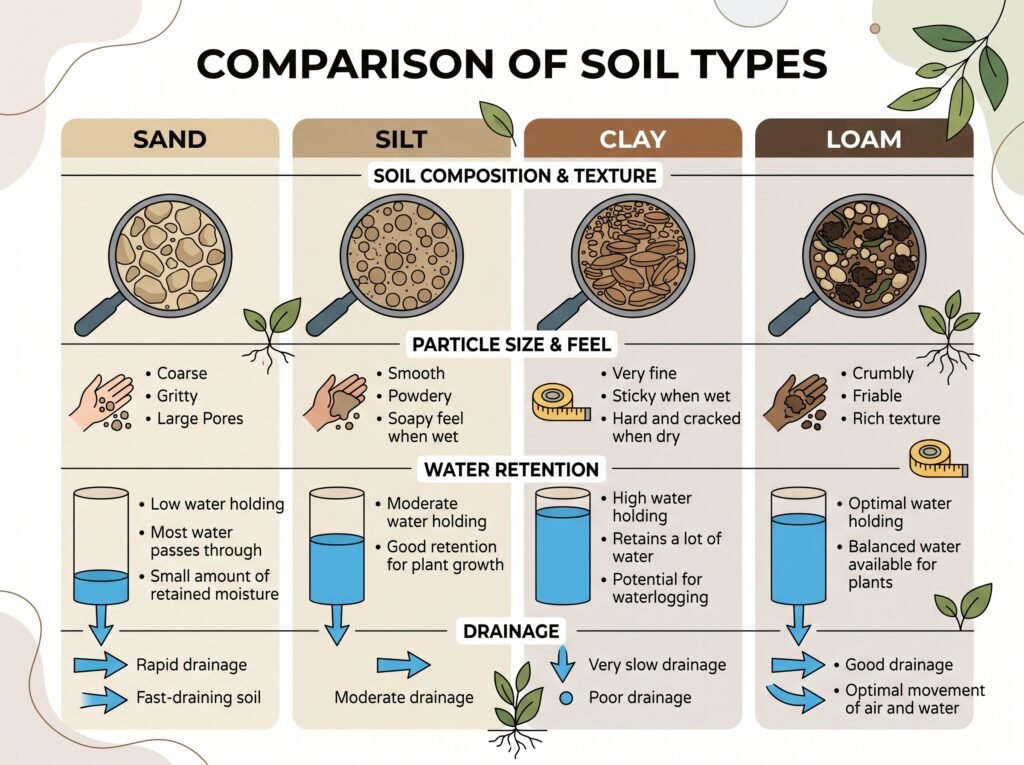
How Your Soil Type Changes How Often You Water
This is the part a lot of general advice skips, and it genuinely changes the answer more than people expect.
Clay Soil
Clay holds onto water longer than other soil types, so if that’s what you’re working with, you can usually water less often, once a week is often plenty, since the soil is still holding moisture from your last watering or rainfall.
Sandy Soil
Sandy soil drains fast and dries out quickly, so it needs more frequent attention.
Watering twice a week, with less water each time, tends to work better than trying to soak it all at once.
Soil Type Quick Reference Table
Soil Type
Water Retention
Suggested Frequency
Clay
High
About once a week
Loam
Moderate
1-2 times a week
Sandy
Low
2-3 times a week, smaller amounts
Quick Tip: If you’re not sure which category your soil falls into, most local cooperative extension offices offer a simple soil texture test, or you can do a rough version yourself at home by squeezing a moist handful and seeing whether it holds together in a ball or falls apart.
How to Tell When Your Garden Actually Needs Water
Numbers and schedules are useful, but your soil and your plants will tell you more than any rule of thumb.
The Soil Feel Test
Grab a handful of soil from a couple inches down.
If it holds together loosely when you squeeze it, you’re fine.
If it crumbles apart or the surface looks cracked and pale, it’s time to water.
Understanding Wilt, When It’s Normal and When It’s Not
Plants often droop a little during the hottest part of the afternoon, and that’s usually just a normal response to heat, not a sign of thirst.
Check back in the early evening.
If they’ve perked back up on their own, you didn’t need to water.
Remember: If they’re still wilted the next morning, that’s the real signal to act.
Watering New Seedlings vs. Established Plants vs. Newly Seeded Beds
Not every part of your garden is at the same stage, and each one has genuinely different watering needs.
Newly Planted Seedlings
A seedling hasn’t built out its root system yet, so it can’t search for water the way an older plant can.
Keep the soil consistently moist for the first week or two, checking daily, especially if it’s hot or windy.
Newly Seeded Areas
Seeds waiting to germinate need the surface kept consistently damp, often a light watering every day or two depending on the vegetable.
Carrots, for example, can take up to three weeks to sprout, and they need steady moisture that whole time or germination suffers.
Common Mistake: One warning worth remembering here, don’t mulch over seeds that haven’t sprouted yet.
It can smother them before they ever get a chance to reach the surface.
Wait until seedlings are a few inches tall before adding mulch around them.
Established Plants
Once plants are settled in and growing well, you can shift to the deeper, less frequent watering described earlier.
Key Takeaway: Established roots can handle a few dry days between waterings far better than a fresh transplant can.
Watering Containers and Raised Beds
Containers and raised beds both drain faster and dry out quicker than a regular in-ground garden, so they typically need more frequent watering, sometimes daily during hot weather, even though the same 1-inch-per-week logic applies underneath it all.
Check containers by sticking a finger an inch into the soil, if it’s dry there, water.
Make sure every container actually has drainage holes too, without them, water pools at the bottom and drowns roots instead of draining away.
Raised beds fall somewhere in between containers and ground soil, usually needing water a bit more often than an in-ground bed with similar soil.
If you haven’t built your bed yet, our how to build a raised garden bed guide covers drainage considerations at the construction stage too.
Quick Tip: If you’re watering a lot through summer, a rain barrel connected to a downspout is worth considering, it’s a free water source and takes some pressure off your water bill during dry stretches.
Best Time of Day to Water
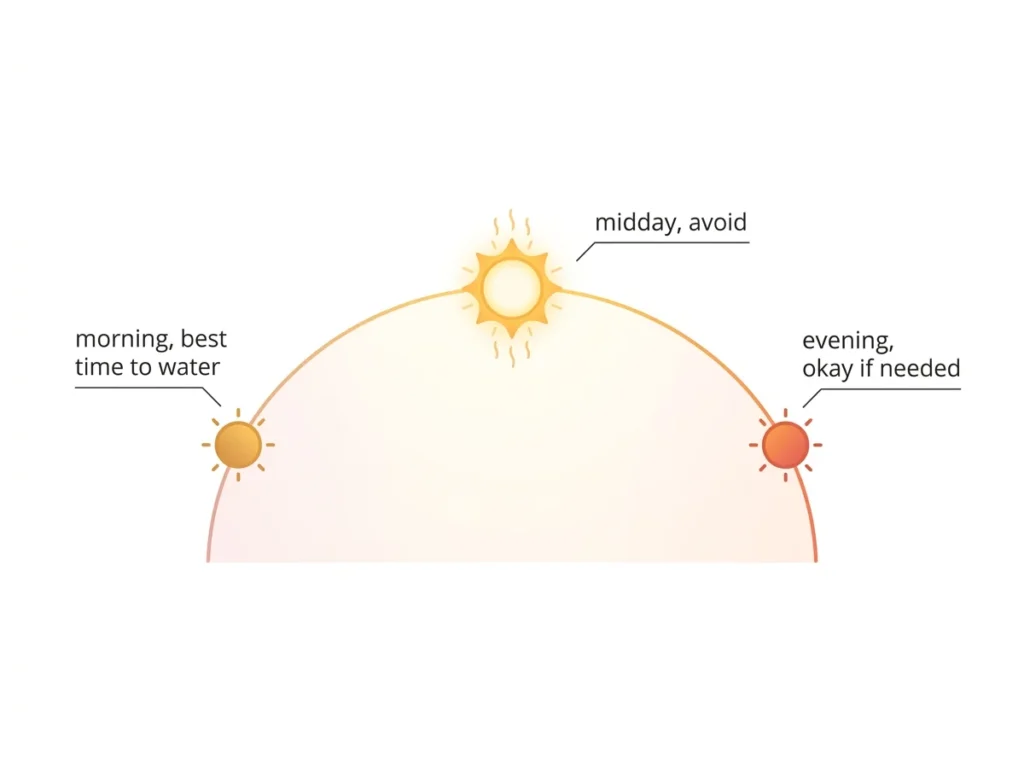
Morning is really the best time.
It’s cooler, so less water evaporates before it reaches the roots, and any water that splashes onto leaves has the whole day to dry off, which matters since wet foliage sitting overnight can encourage disease.
Evening watering is a fine second choice if mornings don’t work for your schedule.
Bottom Line: Try to avoid the middle of the day, that’s when you lose the most water to evaporation for the least benefit.
How to Water the Right Way
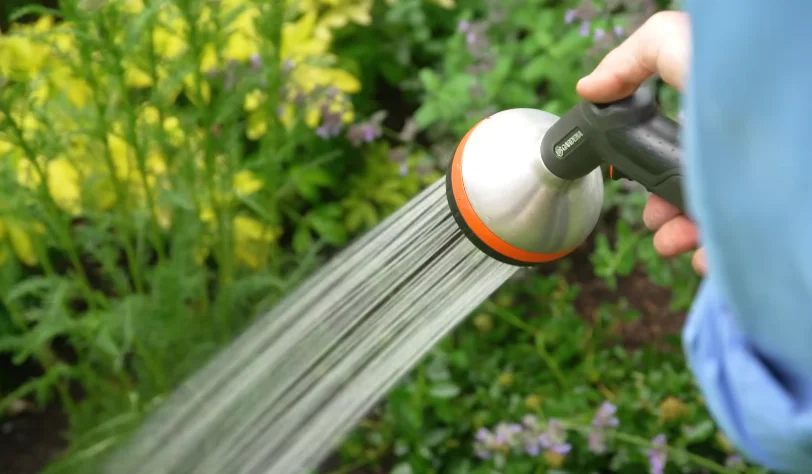
Aim your water at the soil around the base of each plant rather than spraying over the top.
Water at the Base, Not Overhead
Overhead watering wets the leaves, and crops like tomatoes, squash, and cucumbers are especially prone to fungal problems when their foliage stays damp too long.
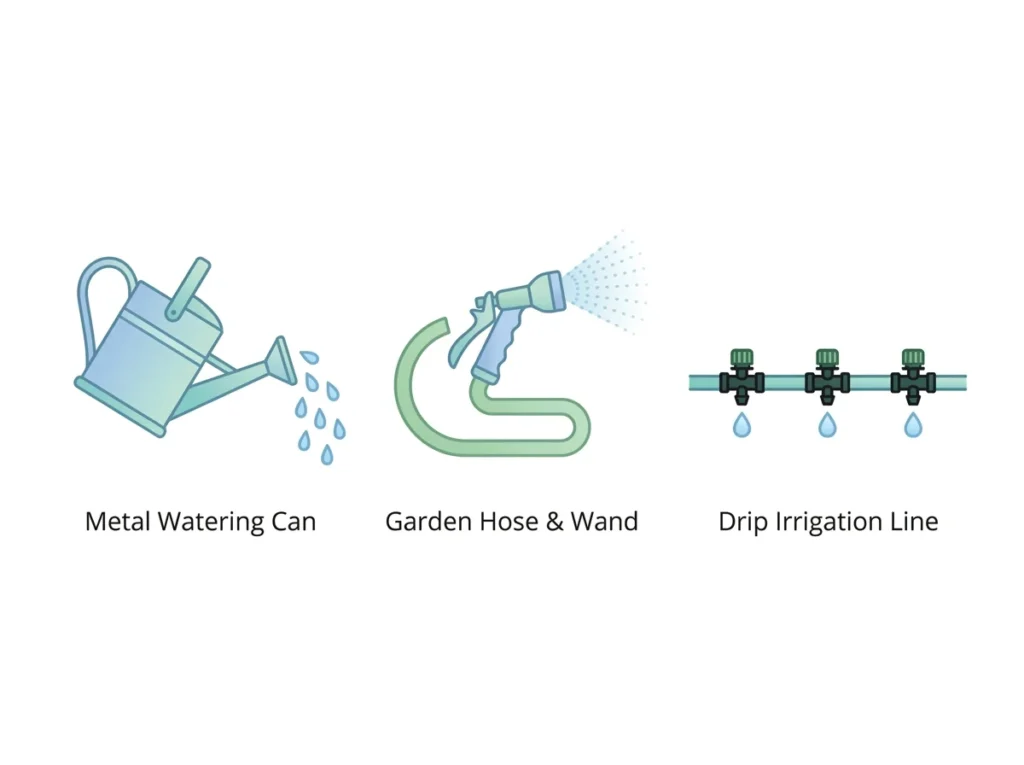
Watering Cans, Hoses, and Drip Irrigation Compared
A watering can or a hose with a gentle wand works fine for a small garden, just hold it at the base of each plant for a bit until the water starts to pool slightly before moving on.
Key Takeaway: For a larger space, drip irrigation is the most efficient option, it delivers water slowly and directly to the roots with very little wasted to evaporation, though it takes more upfront setup and cost than just grabbing a hose.
Don’t Forget to Mulch
A layer of mulch is honestly one of the simplest ways to water less often without your plants suffering for it.
It slows evaporation from the soil surface and reduces transpiration, the process by which plants lose moisture through their leaves, so the whole system holds onto water longer.
Quick Tip: Straw, shredded leaves, or grass clippings all work well spread a couple inches deep around your plants.
Signs of Overwatering vs. Underwatering
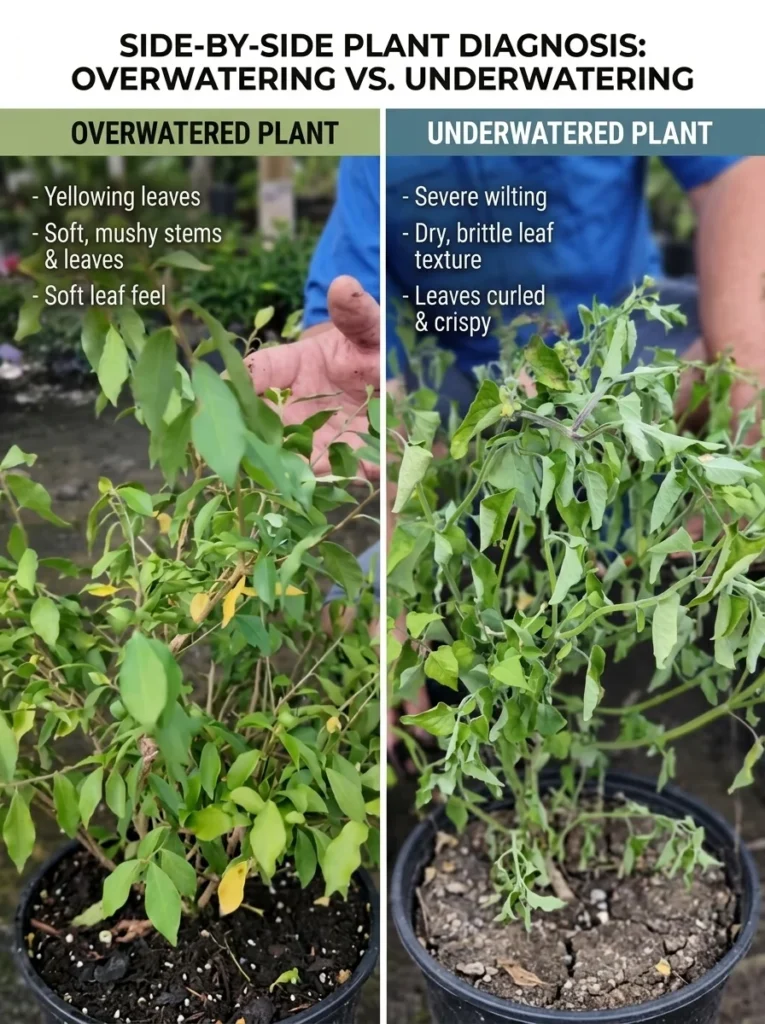
These two problems can honestly look similar at a glance, wilting, yellowing, general unhappiness, so knowing the difference matters.
Comparison Table: Overwatering vs. Underwatering Symptoms
Sign
Overwatering
Underwatering
Leaf color
Yellowing, especially lower leaves
Dull, dry, sometimes curling
Soil
Soggy, waterlogged
Dry, cracked, pulling from container edges
Growth
Slow, sometimes rotting stems
Stunted, small fruit
Common issue
Blossom end rot in tomatoes, root rot
Wilting that doesn’t recover overnight
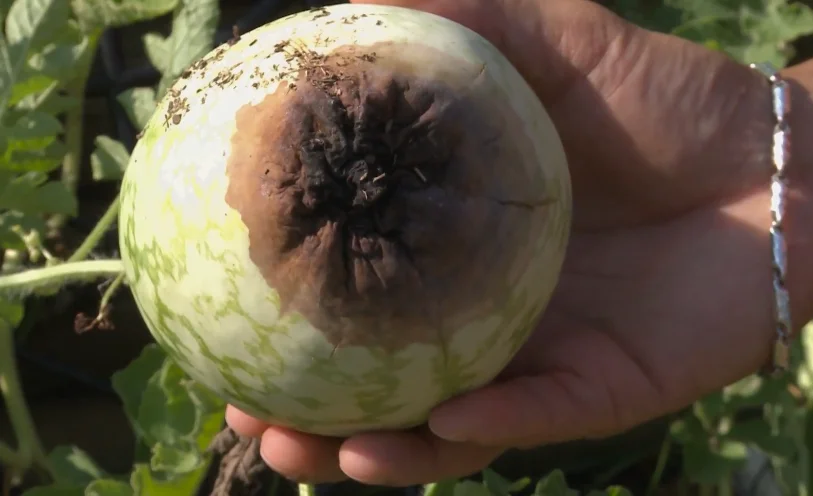
If you’re seeing blossom end rot on tomatoes, that’s actually more often tied to inconsistent watering, swinging between too dry and too wet, than to overwatering alone, so evening out your schedule usually helps more than cutting water entirely.
Remember: The actual mechanism is a calcium deficiency in the developing fruit, and calcium moves through a plant along with water, so irregular watering disrupts that delivery even when your soil has plenty of calcium to begin with.
Watering Guide by Vegetable
Different vegetables have different critical watering windows, times when a dry spell really hurts the harvest.
Watering Needs Table: Common Beginner Vegetables
Vegetable
Critical Watering Time
Gallons per 5-Foot Row, Per Week
Notes
Tomatoes
3-4 weeks after transplanting, and when fruit forms
About 6
Inconsistent watering can cause blossom end rot
Lettuce and greens
Consistently, all season
About 2
Dry spells cause bitterness and bolting
Beans
When flowers and pods form
About 6
Dry soil during pod-forming hurts yield
Carrots
Before soil goes bone dry
About 3-6
Splits if watered heavily after drying out
Peppers
Steady, even moisture throughout
About 3-6
Even watering gives the best flavor
Cucumbers and squash
Frequently, especially as fruit forms
About 3 or more
These are thirsty crops, prioritize them in dry weeks
Adjusting for Heat Waves and Dry Spells
During a genuine heat wave, plants go through real drought stress, meaning they’re losing water faster than their roots can replace it.
Established plants can often handle watering once every few days if you go deep each time, but newly planted seedlings and freshly seeded beds may need daily attention until the heat breaks.
Key Takeaway: I’ve learned to water heavily right before a forecasted heat wave rather than during it, giving the soil a deep reserve to draw from matters more than trying to keep up in real time once the heat actually hits.
Worth knowing too, sometimes a lack of tomatoes has nothing to do with water at all.
Remember: Tomato flowers can drop without setting fruit once nighttime temperatures stay above about 70°F or daytime temperatures climb past roughly 85°F, so if your watering routine is solid and you’re still seeing dropped blooms during a heat wave, temperature is the more likely culprit.
Frequently Asked Questions
Here are answers to common questions about watering a vegetable garden.
How much water do vegetable plants need per week?
About 1 inch per week is the general benchmark, combining rainfall and any watering you do, though this shifts based on your soil type and whether you’re growing in containers.
How do I know if I’m overwatering my garden?
Look for yellowing leaves, soggy soil, and slow or rotting growth. Blossom end rot on tomatoes is often a sign of inconsistent watering rather than just too much.
How often should I water raised beds?
Raised beds typically dry out faster than in-ground gardens, so expect to water somewhat more often, checking the soil a couple inches down is more reliable than sticking to a fixed schedule.
What time of day should I water vegetables?
Morning is best, since it’s cooler and gives leaves time to dry before evening. Evening watering is an acceptable second choice if mornings don’t work.
Should I water every day when it’s hot?
Established plants usually don’t need daily watering even in heat, deep watering every few days is often better. Seedlings and freshly seeded areas are the exception and may need daily attention.
Is it bad if my plants wilt during the day?
Not necessarily. Midday wilting in hot weather is often normal and temporary. Check again in the evening, if the plant has recovered, it didn’t need water.
Can I overwater a plant even if I’m following the 1-inch rule?
Yes. In heavy clay soil or a container without good drainage, that same amount of water can sit around the roots too long and cause problems, so the 1-inch rule is a starting point, not a guarantee, always check your actual soil alongside it.
What to Do Next
Once your watering routine feels solid, mulching properly is the next easiest way to reduce how often you need to reach for the hose.