The first tomato I ever grew came from a seedling I bought on a whim at a hardware store, no plan, no idea what variety it even was.
It did fine, better than fine actually, and that’s honestly how a lot of people start with tomatoes. You don’t need to get everything right the first time.
This guide covers the whole tomato growing process, from deciding whether to start from seed or seedling all the way through harvest.
Container growing gets a brief mention near the end, with full depth living in our dedicated container guide, and the same goes for seed-starting mechanics and variety deep-dives, those live in their own linked guides too, so this page can stay focused on the core growing journey.
Quick Overview
- Choose seedlings or start from seed 6-8 weeks before your last frost
- Pick a sunny, well-drained spot with good soil
- Wait until after your last frost and warm nights to transplant
- Plant deeply, water consistently, and set up support early
- Fertilize as needed and prune indeterminate varieties
- Watch for common problems like blossom end rot and pests
- Harvest when fruit reaches full color and gives slightly to a gentle squeeze
Let’s walk through each step properly.
Should You Start Tomatoes from Seed or Buy Seedlings
Both paths work, and honestly, most gardeners end up doing a mix of both over the years.
Starting from Seedlings
Buying seedlings means someone else handled the tricky early weeks for you.
It’s faster, it needs no special equipment, and it’s genuinely the easier starting point if this is your first tomato season.
The tradeoff is variety selection, big box stores usually carry just a handful of common types, though farmers markets often have more interesting options.
Starting from Seed
Starting from seed takes more time and setup, but it opens up far more variety choices and can save money if you’re planting a lot of tomatoes.
It’s worth considering if you:
- Already have some seed-starting experience
- Want unusual varieties
- Are leaning into growing more of your own food long term
Key Takeaway: Seedlings are the easier, faster starting point for beginners. Seeds open up more variety and can save money at scale.
Choosing a Tomato Variety
Before you plant anything, it helps to understand the two basic tomato growth types and roughly how many plants you’ll actually need.
Determinate vs. Indeterminate, What’s the Difference
This is one of those terms that gets thrown around constantly in tomato advice without ever really being explained, so let’s fix that here.
Determinate tomatoes grow to a set size, produce most of their fruit in a shorter window, and don’t need much pruning.
Indeterminate tomatoes keep growing and producing until frost kills them, and they need regular pruning to stay manageable.
Comparison Table: Determinate vs. Indeterminate
| Determinate | Indeterminate | |
|---|---|---|
| Growth habit | Stops at a set height | Keeps growing all season |
| Pruning needed | Minimal to none | Regular |
| Harvest pattern | Most fruit ripens in a shorter window | Steady trickle all season |
| Good for | Canning, smaller spaces | Fresh eating over a long season |
Days to Maturity, Working Backward from Your Frost Date
Every tomato variety lists a “days to maturity” number on the seed packet or plant tag, this is roughly how long from transplant to first ripe fruit.
Count that number forward from your expected transplant date, then check it against your first fall frost.
Quick Tip: If you’re in a short-season climate, choosing a variety with a lower days-to-maturity number, somewhere in the 55-65 day range, gives you a much better shot at an actual harvest before cold weather shuts things down.
How Many Tomato Plants Do You Need
This trips up a lot of beginners who either end up with three plants and barely enough for salads, or twelve plants and more tomatoes than any household can handle.
As a rough guide:
- 2-3 plants per person covers fresh eating
- 4-6 plants per person gives you enough extra for canning or sauce making too
When to Plant Tomatoes
Starting Seeds Indoors
If you’re starting from seed, sow indoors about 6 to 8 weeks before your last expected spring frost date.
This gives seedlings enough time to grow sturdy before it’s warm enough to move them outside.
What is hardening off? Hardening off means gradually getting an indoor-grown seedling used to real outdoor conditions, sun, wind, and temperature swings, before planting it outside for good. Set seedlings outside for a few hours a day over about a week, increasing the time gradually. Skip this step and even a healthy-looking seedling can go into shock once it’s exposed to full outdoor conditions all at once.
When to Transplant Outdoors
Wait until all risk of frost has passed and nighttime temperatures are reliably staying above 50°F.
It’s tempting to rush this once the weather feels nice, but tomatoes planted too early into cold soil just sit there and sulk.
I’ve found tomatoes planted a little later in the season usually catch up to, and sometimes surpass, ones planted too early into cold ground.
Common Mistake: Don’t assume a seedling you bought at the store has already been hardened off, especially from a big box retailer. Harden it off yourself regardless of where it came from.
The “Rules of Threes” Transplant Readiness Check
A simple way to judge if a seedling is ready to go in the ground:
- Look for at least 3 inches of height
- Look for 3 sets of true leaves
Some gardeners wait until the seedling is roughly three times the size of its nursery pot, giving you enough stem length to plant deeply, which matters more for tomatoes than almost any other vegetable.
Bottom Line: Start seeds 6-8 weeks before your last frost, transplant only after frost risk and cold nights have passed, and always harden off first.
Where to Plant Tomatoes
Sun Requirements
Tomatoes want at least 6 hours of direct sun a day, and more is generally better.
This matters even more in cooler northern climates with shorter growing seasons.
Soil Requirements and pH
Tomatoes like rich, well-drained soil with a slightly acidic pH, somewhere around 6.2 to 6.8.
If you’re not sure where your soil stands, a basic home test kit or a local extension office test will tell you.
Here’s how sun and timing guidance shifts depending on where you garden:
Regional Growing Guidance Table
| Region | Sun Guidance | Fall Growing Note |
|---|---|---|
| Northern climates (Zone 5 and below) | Full sun, 8+ hours ideal | Not applicable, season ends at first frost |
| Southern climates (Zone 7 and up) | Full sun, some afternoon shade helpful in peak summer | Consider planting a second round for fall harvest |
| Very hot zones (Zone 9-10) | Afternoon shade protection recommended | Fall and winter planting often outperforms summer |
Remember: Tomatoes tend to drop blossoms and stop setting fruit once temperatures climb above about 86°F, which is exactly why hot-climate gardeners often shift tomatoes to a fall or even winter growing window instead of fighting through peak summer heat.
Crop Rotation
Avoid planting tomatoes where you grew tomatoes, peppers, eggplant, or potatoes in the past couple years, these are all nightshade family members and share similar soil-borne disease risks.
How to Plant Tomatoes in the Ground
Planning to grow in containers instead? See our container gardening guide for the four key differences between container and in-ground tomato growing.
Preparing the Planting Hole
Dig a hole deeper than you’d expect, tomatoes are one of the few vegetables that actually benefit from deep planting, since roots will grow along any buried section of stem.
Mix in a handful of compost and a bit of balanced fertilizer at the bottom of the hole if you’d like, just make sure it’s mixed into the soil rather than sitting directly against the roots.
Deep Planting and Trench Planting
Remove the lower leaves from your seedling, roughly the bottom half to two-thirds of the stem, and bury the plant up to just below the remaining leaves.
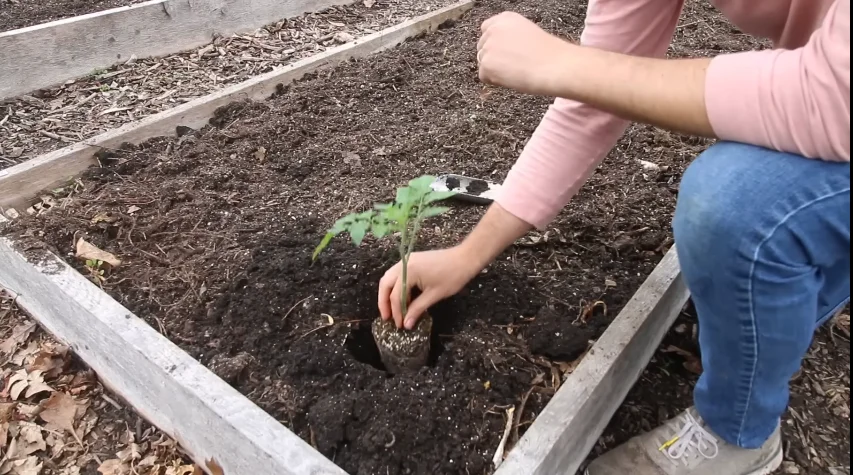
Quick Tip: If your seedling is tall and leggy, you can lay it sideways in a shallow trench instead of straight down, burying most of the stem horizontally. Either method encourages a much stronger root system than a shallow planting would.
Spacing
Give tomatoes 18 to 36 inches between plants, the exact number depends on the variety and how you plan to stake or prune them.
Sprawling indeterminate types need more room than compact determinate ones.
Step-by-Step Planting Instructions
- Confirm your seedling is hardened off and there’s no frost in the forecast
- Transplant on a cloudy day or in the evening if you can, to ease the shock of direct sun
- Dig your hole and remove lower leaves as described above
- Set the plant in place and backfill with soil
- Water deeply right at the base
- Add mulch around the base, keeping it a couple inches from the stem
Setting Up Support at Planting Time
Install your cage, stake, or trellis right when you plant, not weeks later.
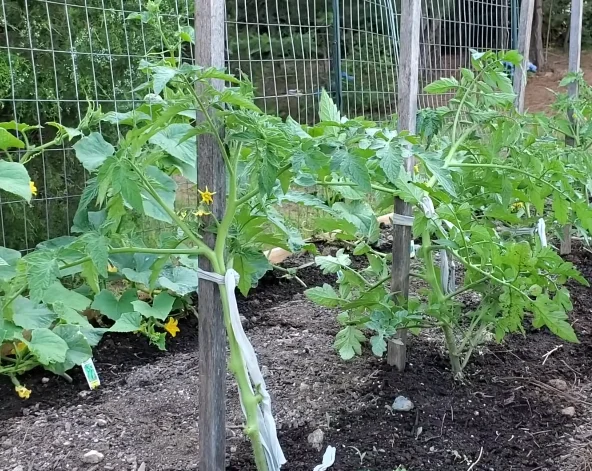
Common Mistake: Waiting until the plant is already sprawling risks damaging roots or wrestling with a much bigger, less cooperative plant.
Avoiding Transplant Shock
A little wilting in the day or two after transplanting is normal and usually resolves on its own.
If a plant still looks droopy several days later, check that it’s getting consistent water and wasn’t planted into soil that was still too cold.
Key Takeaway: Most transplant shock traces back to one of two things, inconsistent watering or soil that’s still too cold.
Caring for Tomato Plants
Once your tomatoes are in the ground, ongoing care really comes down to a handful of things, watering, feeding, supporting the plant, and pruning.
Watering Tomatoes
Aim for about 1 inch of water per week, up to 2 inches during the hottest stretches of summer.
Water deeply once or twice a week rather than a little every day, and always water the soil, not the foliage, to help keep disease at bay.
Fertilizing Tomatoes
Work compost and a slow-release fertilizer into the soil before planting, then feed every 2-3 weeks during the season with a balanced, water-soluble fertilizer, ideally one slightly higher in phosphorus and potassium than nitrogen.
Quick Tip: Reading Your Plant’s Signals. One of the more useful things I’ve learned is that tomatoes tell you when they’re hungry. Pale, yellow-green foliage and slowed growth are usually a sign it’s time to feed, rather than sticking to a rigid schedule regardless of how the plant actually looks.
Pruning and Training
Only indeterminate varieties need real pruning, determinate types should mostly be left alone.
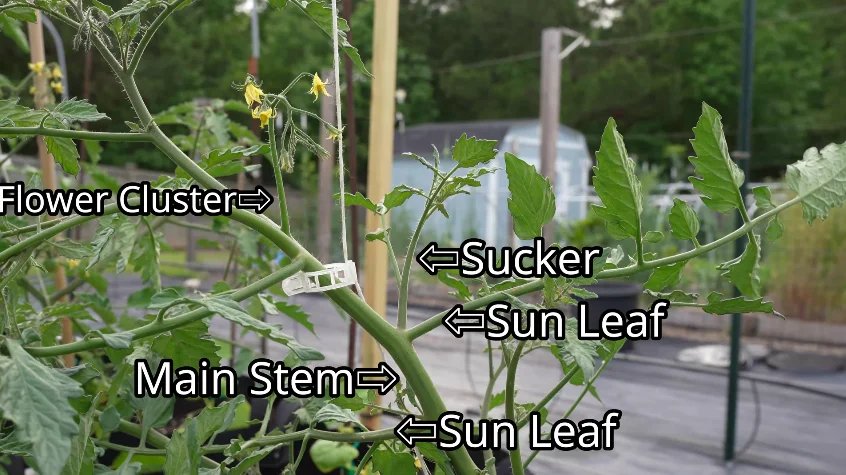
What are suckers? Suckers are the small shoots that sprout in the joint between the main stem and a branch. Left unpruned, they’ll grow into full stems themselves, quickly turning one plant into a tangled mess.
Most gardeners keep 1 to 3 main stems per plant and prune out the rest.
Topping Tomato Plants Near Season’s End
About 4 to 6 weeks before your expected first fall frost, cut off the main growing tip of indeterminate plants.
This stops the plant from putting energy into new growth and redirects it toward ripening the fruit that’s already set, giving you a better shot at a full harvest before the cold shuts things down.
Bottom Line: Water deeply, feed every 2-3 weeks, prune indeterminate varieties regularly, and top plants a month or so before your first fall frost.
Companion Plants for Tomatoes
Basil is a classic pairing, it’s thought to help repel certain pests, and it’s simply convenient to have growing right next to your tomatoes come sauce season.
Marigolds, mint, and nasturtium are all commonly interplanted too, each helping attract beneficial insects or deter unwanted ones.
Common Tomato Problems
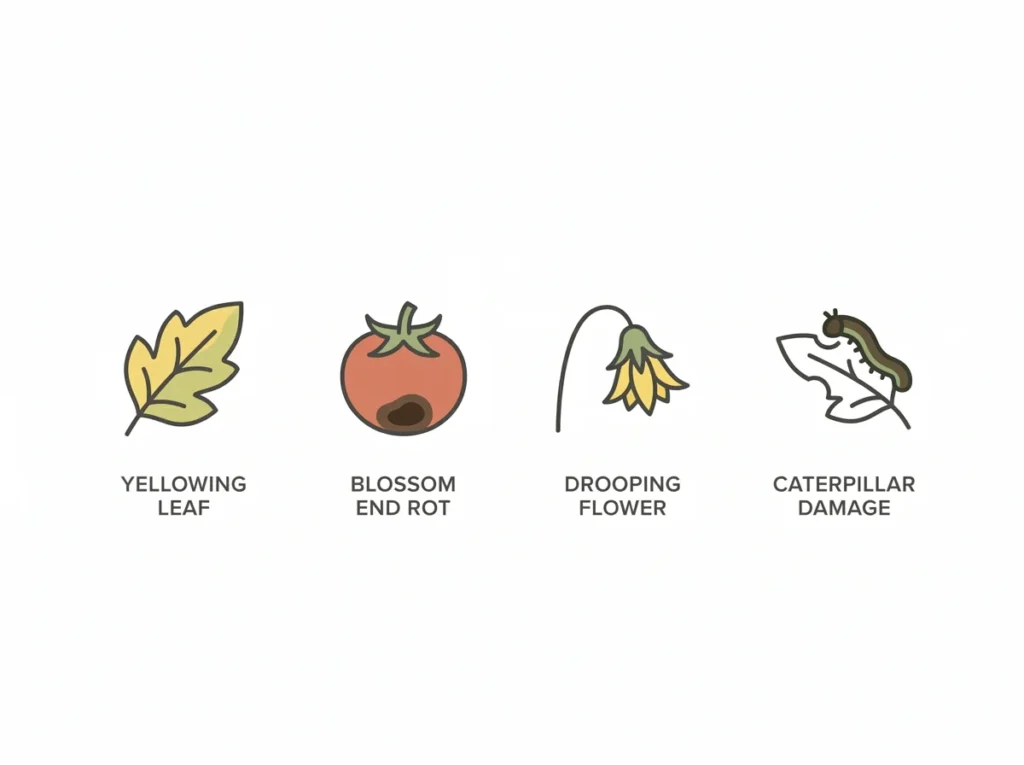
Why Isn’t My Tomato Plant Producing Fruit
If your plant looks healthy but isn’t setting fruit, heat is the most common culprit.
Tomato flowers can drop without setting fruit once daytime temperatures climb above roughly 85°F or nighttime temperatures stay above 70°F, this is a temperature issue, not a watering or fertilizing problem, and it usually resolves once conditions cool back down.
Blossom End Rot Explained
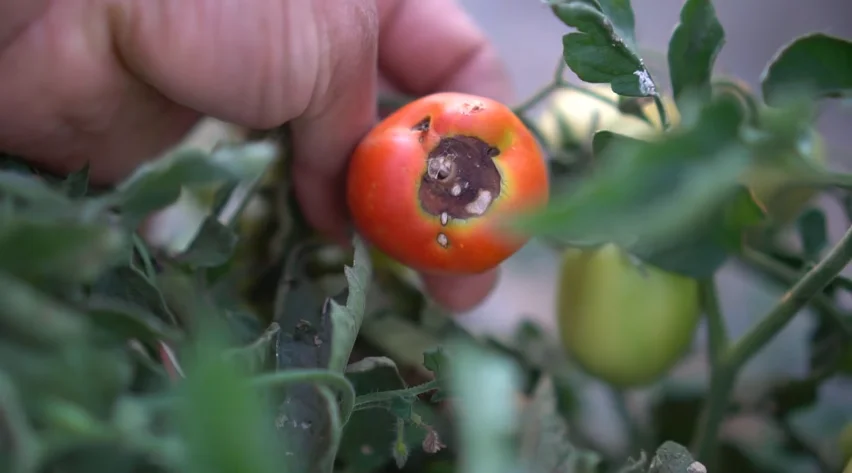
Blossom end rot shows up as a dark, sunken patch on the bottom of the fruit, and it’s genuinely one of the most common tomato complaints out there.
It’s caused by a calcium deficiency in the developing fruit, but the real root cause is usually inconsistent watering, not a lack of calcium in the soil.
Calcium moves through a plant along with water, so swinging between too dry and too wet disrupts that delivery even when your soil has plenty of calcium to begin with.
Remember: Evening out your watering schedule fixes blossom end rot far more often than adding a calcium supplement does.
Common Tomato Pests
Check the undersides of leaves regularly for aphids and their eggs, and hand-pick any you find into a bucket of soapy water.
Tomato hornworms are large enough to spot and remove by hand too, if you notice stripped leaves, look closely, they’re usually nearby, camouflaged well against the stem despite their size.
Quick Tip: Catching pest problems early, while numbers are still small, makes a real difference, letting them build up for a few weeks turns a five-minute hand-picking job into a much bigger headache.
Preventing Disease
Keep your tomato plants pruned for airflow, clean your pruners between plants, and never work in the garden when foliage is wet, wet leaves spread disease far more easily than dry ones.
A thick layer of mulch also helps by keeping soil-borne spores from splashing up onto lower leaves during watering or rain.
I switched from straw to compost mulch a few years back specifically because straw seemed to give slugs a place to hide, and the compost has worked just as well for moisture retention without the extra pest problem.
Here’s a quick reference for diagnosing the most common issues:
Troubleshooting Table: Symptom, Likely Cause, Fix
| Symptom | Likely Cause | Fix |
|---|---|---|
| Yellow lower leaves | Nitrogen deficiency or normal aging | Feed if new growth also looks pale, otherwise remove and monitor |
| Dark sunken spot on fruit bottom | Blossom end rot, inconsistent watering | Even out watering schedule |
| Flowers dropping, no fruit | Heat stress | Wait for cooler temperatures, avoid extra fertilizer |
| Wilting despite moist soil | Disease or root damage | Check stem for lesions, inspect roots |
| Holes in leaves | Pests like hornworms or beetles | Hand-pick pests, check undersides of leaves |
Harvesting Tomatoes
How to Tell When Tomatoes Are Ripe
A ripe tomato gives slightly when you gently squeeze it and matches the color described on the seed packet or plant tag.
Darker varieties, purples and near-blacks especially, can be trickier to judge by color alone, so lean more on that gentle give.
Ripeness is also partly personal preference, some gardeners pick fully ripe, others prefer picking just before that point and letting the last bit happen on the counter, it’s worth trying both across a season to see what you actually like.
Can Tomatoes Ripen Off the Vine
Yes, if a tomato has already started turning color, it will continue ripening on the counter once picked.
A fully green tomato that isn’t meant to be eaten green won’t ripen off the vine though, so timing matters if you’re picking early ahead of a frost.
Quick Tip: Late summer harvests can pile up fast, it’s worth having a plan, whether that’s canning, sauce, or just a list of friends happy to take extra, before the rush actually hits.
Growing Tomatoes in Containers or Raised Beds
Tomatoes do well in both, with a few adjustments.
- Containers need to be large, at least 5 gallons for compact varieties and closer to 15-20 gallons for full-size indeterminate types, and they dry out faster, often needing daily watering in summer.
- Raised beds behave more like in-ground growing but warm up earlier in spring, which can work in your favor for an earlier start.
For the full breakdown of container-specific variety choices, sizing, and watering strategy, see our dedicated container gardening guide.
Frequently Asked Questions
How do you prepare soil for next year’s tomatoes?
To prepare soil for next year’s tomatoes, remove old tomato plants and garden debris after harvest, then add compost or well-rotted manure to replenish nutrients. Avoid planting tomatoes in the same spot every year, as rotating crops helps reduce soil-borne diseases and pests. Before planting next season, test the soil if needed and adjust the pH to around 6.0–6.8 for healthy growth.
Do tomatoes need full sun or heat?
Tomatoes need full sun more than extreme heat. They grow best with at least 6 to 8 hours of direct sunlight each day and warm temperatures between 70°F and 85°F (21°C–29°C). While tomatoes enjoy warm weather, excessive heat above 90°F (32°C) can reduce flowering and fruit production.
Should you water the whole tomato plant?
No. Water the base of the tomato plant, not the leaves or stems. Directing water to the soil encourages deep root growth and helps reduce fungal diseases caused by wet foliage. Water deeply and consistently, allowing the soil to dry slightly between watering sessions.
Can you grow just one tomato plant?
Yes. A single tomato plant can produce a good harvest, especially if you choose a productive variety and provide proper sunlight, water, and care. However, growing two or more plants gives you a longer harvest and a greater variety of tomatoes if space allows.
What to Do Next
Once you’re harvesting regularly, the next questions are usually about what to do with all that fruit and how to prepare for next season.
Our guides on storing and preserving homegrown vegetables and saving seeds from your garden pick up right where this one leaves off.
