
Calculate Your Plant Spacing
Plant spacing
Your Planting Plan
Planting layout
Standing in the seed aisle trying to guess how many tomato plants will fill your new raised bed is a special kind of frustrating. Buy too few and you've got bare dirt by July. Buy too many and you're thinning out perfectly good seedlings you already paid for.
The calculator above does the math for you. Punch in your garden's size, pick what you're planting (or set your own spacing), and it'll tell you how many plants to buy, how many rows you'll need, and roughly what the layout looks like before you ever pick up a trowel.
Here's how to get the most out of it, plus the spacing logic behind the numbe
How to Use the Calculator
- Pick your plant. The dropdown covers common vegetables like tomatoes, peppers, lettuce, and carrots, each preloaded with a sensible spacing. Growing something that isn't listed? Choose "Custom Plant" and enter the spacing from your seed packet or plant tag.
- Enter your garden's length and width. Feet, meters, or inches — whichever is easiest to measure with what you've got on hand.
- Choose a planting method. "Traditional rows" spaces plants in straight lines with room between rows for walking and watering. "Intensive / square foot" packs plants closer together in a bed you reach from the sides, with no paths in between.
- Hit calculate. You'll get a plant count, a simple visual layout, and the exact spacing numbers used.
If the result looks off, double-check your units first — a garden entered in inches instead of feet will throw the math way off.
Quick tip: When in doubt, round your plant count down, not up. It's easier to tuck in a few more seedlings later than to rip out overcrowded ones.
Traditional Rows vs. Intensive Planting: Which One Should You Pick?
If you've never gardened this way before, the two methods solve different problems.
Traditional rows work well when you need to walk between plants — to weed, harvest, or run a hose down the line. This is the classic backyard vegetable garden layout, and it's the safer default for beginners because it gives every plant room to breathe.
Intensive planting (sometimes called square-foot gardening) skips the walking paths and spaces plants closer together, so you fit more into a small raised bed. It works because you're reaching in from the edges instead of walking between rows. It's a great fit for compact crops like lettuce, carrots, and beets — less so for a sprawling zucchini plant that needs elbow room [Source needed: confirm which crops handle intensive spacing well vs. poorly for regional climate variation].
Neither is "better" outright it depends on how much space you have and how you like to move through your garden.
Common Vegetable Spacing at a Glance
These are the same starting numbers built into the calculator above. Local growing conditions, variety, and how you're supporting the plant (staked, caged, trellised) can shift these — treat them as a starting point, not a rule.
| Vegetable | Plant Spacing | Row Spacing | Works for Intensive? |
|---|---|---|---|
| Tomato | 24 in | 36 in | No — needs room for airflow and support |
| Pepper | 18 in | 24 in | No |
| Cucumber | 12 in | 36 in | No — sprawls unless trellised |
| Zucchini | 36 in | 48 in | No |
| Broccoli / Cabbage | 18 in | 24 in | No |
| Bush Beans | 6 in | 18 in | Yes |
| Lettuce | 8 in | 12 in | Yes |
| Spinach | 6 in | 12 in | Yes |
| Carrots | 3 in | 12 in | Yes |
| Radishes | 3 in | 6 in | Yes |
| Onions | 4 in | 12 in | Yes |
| Beets | 4 in | 12 in | Yes |
| Peas | 3 in | 18 in | No — grows tall on a trellis |
Heads up: Spacing on a seed packet is usually the minimum distance, not the ideal. When your soil is on the leaner side, giving plants a little extra room reduces competition for nutrients and water.
Plant Spacing Quick-Reference Table
Prefer to do the math yourself instead of using the calculator above? Multiply your garden's total square footage by the number below to get your plant count.
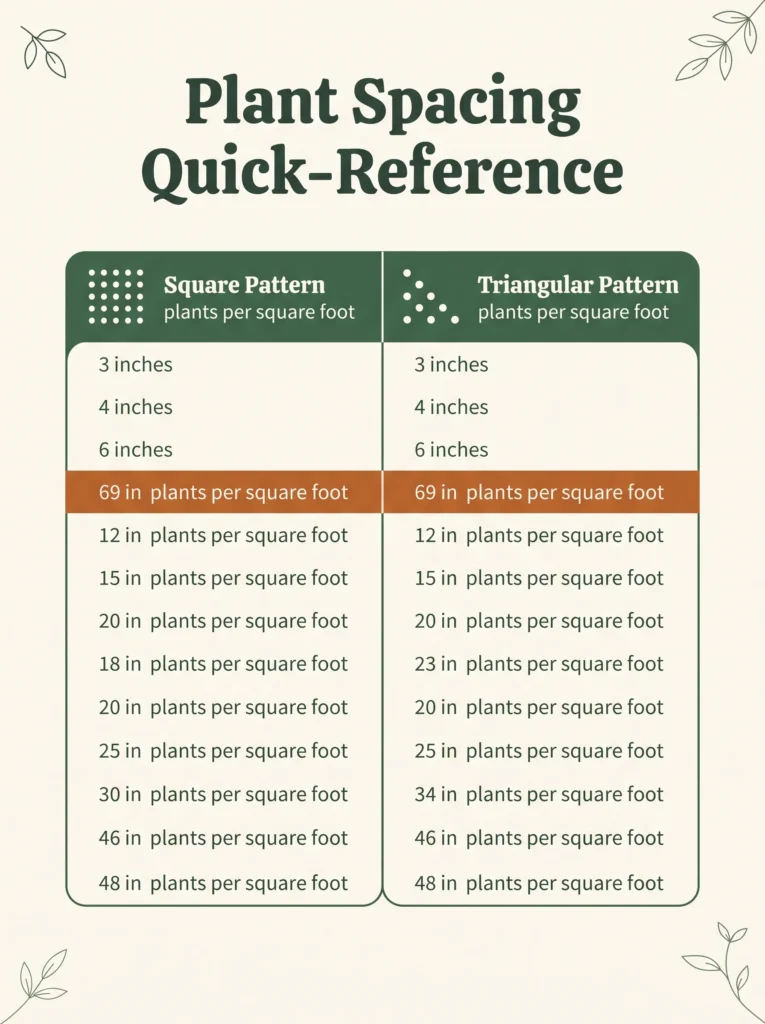
Example: A 100 sq ft bed at 12" spacing needs about 100 plants in a square pattern, or 115 in a triangular one.
Mistakes That Throw Off Your Plant Count
Forgetting mature size. Spacing isn't about how big the seedling is today — it's about how big the plant gets at full size. A tomato seedling looks lonely at 24 inches apart in April; by August, it won't.
Mixing up plant spacing and row spacing. Plant spacing is the distance between plants within a row. Row spacing is the distance between rows. Swapping these in the calculator will either overcrowd your bed or waste a lot of space.
Not accounting for paths. If you're using traditional rows, remember you'll walk between them. A garden that's technically wide enough for four rows might only comfortably fit three once you leave room to move.
Skipping the "custom plant" option. Every seed packet and plant tag lists its own recommended spacing, and it can vary quite a bit by variety a determinate bush tomato needs less room than a sprawling indeterminate vine, even though they're both "tomatoes."
FAQ
How accurate is this plant spacing calculator?
It gives you a solid estimate based on standard spacing guidelines for each crop. Actual counts can shift once you factor in bed edges, trellises, or irregular garden shapes. Treat the number as a strong starting point, not a guarantee.
What's the difference between plant spacing and row spacing?
Plant spacing is how far apart individual plants sit within the same row. Row spacing is the distance between one row and the next. Both affect how many total plants fit in your garden.
Can I use this for a raised bed?
Yes. Just enter your raised bed's actual length and width, and consider using the intensive planting method if you're not leaving walking paths inside the bed itself.
Why does intensive planting fit more plants than traditional rows?
Because there are no walking paths taking up space between rows. You're using the entire bed for plants instead of splitting it between plants and access room.
What if my plant isn't in the dropdown list?
Choose "Custom Plant" and enter the spacing listed on your seed packet or plant tag. That number is usually the most reliable source for the specific variety you're growing.